Sunday, 11 February 2018

13. PIRATES OFF THE BRITISH MAIN

In 1964, like modern day successors to the 16th century French, Dutch and English privateers off the Spanish Main, suddenly a flurry of radio pirates popped up along the British Main, being the Essex coast and the Thames Estuary; often described as pirate alley. Un­like their Caribbean predecessors, who went after Spain’s sil­ver bullion, the pop pirates had set their sights on London’s adver­tising dollar in an attempt to break the monopoly of the BBC and the large record com­­panies. The pioneer in the race to lay claim to the lucrative London market was Radio Caroline, financed by Irishman Ronan O’Rahilly, who hoped to emulate Veronica’s success. A former Danish passenger ferry Frederica was bought, renamed Caroline and fitted out as a radio ship in the Irish port of Greenore, owned by Ronan’s family. After two days of tests off Felixstowe Britain’s first off­shore station opened officially on Easter Sunday, March 29th 1964. Ronan had been egging on everyone connected with the organisation in order to be able to inaugurate the station on that day. 

In fact, at the time, I only heard about Caroline going on the air on Easter Monday, as I was spending my school holidays in the small Belgian village of Beerzel (near Malines) where my maternal grandparents lived. My immediate problem was that Caroline’s broadcast on the announced 199m (in fact 1520 kHz) was too close to Belgian regional radio in Antwerp. But as luck would have it my niece Maria Goris, who had just married, was in possession of a large Phillips portable radio, which could be turned away from most of the splutter involuntarily caused by the Antwerp station on the adjacent channel. After a few minutes’ tuning and turning the sound of Caroline’s bell rang through the small house. It would change my life forever. Over the years the start of Caroline has also become a very important date to me personally. More than half a century later I still use it as an all important benchmark. In my life BC means ‘Before Caroline’.

More of AJ's radio- and other anecdotes.

12. CONCRETE PROJECT OFF BELGIUM

THE UILENSPIEGEL SAGA

As my paternal grand­mother, Adrienne Vantorre, was spending the weekend, lunch was somewhat delayed at our house on Saturday October 13th 1962. That also meant that my customary quick dial through the Medium Wave was a bit later than usual. But, around 14.25 hrs it happened to be just in time to hear Belgium’s first offshore station go on the air. Reception was very strong as the Uilenspiegel, a vessel made out of concrete, was anchored off Zeebrugge, where I lived and still do. 

A different music era had just started -not on account of the new radio station- but because just a week earlier the Beatles had released ‘Love me do’, their first single for EMI. However, less than a fortnight later the world was in the grip of the Cuban missile crises. With the threat of nuclear holocaust hanging over us, we racked our brains over some sort of protection. With Uilenspiegel providing some entertainment in the background my father and I set to work in the back yard. The underground rainwater storage tank in reinforced concrete was blocked, drained and dried out, to serve as a makeshift fallout shelter for my mother and me. My father was sure he would be at sea should the Third World War kick off. Luckily we never had to make use of the dark and spooky underground chamber. 

TAUNTING AUTHORITY
Uilenspiegel was the initiative of 73-year old Georges De Caluwé, from Edegem near Antwerp. In the previous months he had purchased the 585-ton supply boat ‘Crocodile’ in the French port of Brest. Well before the war, the vessel in reinfor­ced concrete, had been cast in a mould, like a few of its sister ships. During the Summer of 1962 transmitting equipment was installed on board the vessel in Antwerp. It was subsequently towed to sea, having been aptly renamed ‘Uilenspiegel’ after a legendary sixteenth-century Flemish folk hero who was famous for taunting authority. The vessel was anchored at 51° 28’ North, 3° 12 East. The station announced itself as “Radio Antwerpen van op het schip Uilenspiegel op de Noordzee”, but everyone simply called it Radio Uilenspiegel. Station identification was accompanied by music from ‘Till Eulenspiegel’s Merry Pranks’, a tone poem by Richard Strauss. It is a lilting melody that reaches a peak, falls downward, and ends in three long, loud notes, each progressively low­er.   Broadcasts  from  Uil­enspiegel  were  on 1492 kHz (201m), a fre­quency chosen  be­cause  it was very close to the channel used by the transmissions for Ant­werp by Belgium’s state-run regional radio. Apart from a half hour pro­gram­me ‘Y’a de la mu­sique’ at 16.30 in French, all other program­mes were in Flemish and pre-re­corded on land. In all 18 people were employed

With Uilenspiegel Georges De Caluwé got his own back on the Belgian authorities. After the war the Pierlot government, returning from exile in London and clearly suffering from Goebbels-syn­dro­me, had refused to renew the licences of all independent broadcasters in the country. Since 1922 and until the Nazi invasion De Caluwé had been running a small commercial station. People called it ‘Radio Kerkske’, since the aerial had been erected on the tower of the Protestant church in Edegem. In the face of the intransigence of the Belgian government De Caluwé had sworn to get his station back on the air, even if it meant swapping a church for a ship of cement.

POPULAR, PROUD AND LEGAL

It was the succes of Veronica and Scandinavian stations such as Radio Mercur and Radio Syd that had inspired Georges De Caluwé. In spite of his age he regularly made the 6 mile dash to Uilen­spiegel’s anchor­age to check on the equipment. Whenever the former shrimper, called ‘Nele’, after the spouse of legendary Tijl Uilen­spiegel, took De Caluwé out to the ship, he invariably went live on air for a few minutes around 12.25 hrs near the end of the pro­gramme "Groe­ten van Uilen­spiegel". In his chat he reported on any im­provements that had been carried out on board. One Saturday he announced that the station could now also be heard on 7.600 kHz in the 41 m band shortwave. He called it an exciting moment and just days later reception reports were received from as far away as Canada.

In the evening the medium wave transmission could be picked up in large parts of Europe. Georges De Caluwé explained to a Swedish journalist that in the first few weeks of broadcasting he had received over a thousand letters in the station’s post office box in Zeebrugge. Apart from Belgium reception reports were main­ly sent in from The Netherlands, the Uni­ted Kingdom and the Scandinavian countries. During the day however reception on 1492 kHz was often troublesome in parts of Brussels and Antwerp. To improve coverage a move to a more favourable frequency was being considered, but this never materialised.

De Caluwé also stressed that he was “proud of the legality of his station”. The ship was registered in Panama, and every month he paid any copyright dues to Sabam, the Belgian performing rights society. Furthermore all provisions and tapes that went out to the vessel from Zeebrugge and occasionally Blankenberge were checked by Customs and were given an export license.

MIDNIGHT CLOSEDOWN BATTLE

Programmes on the Uilenspiegel commenced every morning at seven with traditional Westminster chimes. Apart from a wide selection of pop hits, also opera, operettas and some classical music could be heard on the station. The transmitting day ended at midnight. From the start Uilenspiegel had been a thorn in the side of Belgian national radio, but it was especially this late closedown which presented the state broadcaster with a pretty problem. In those days shut down time for the NIR was at 23.17 hrs. For years any later programming had been blocked by the unions. They argued that announcers and technicians working at the Flageyplein broadcasting house in the Brussels suburb of Elsene had to be able to catch the last bus home. Hence the most curious close­down time. However, just a week after Uil­enspiegel appeared on the scene, national radio also stay­ed on the air until midnight. The unions had relented. How did the announcers and technicians get home? Well, they used their cars, as they had always done.

JUST 66 DAYS AT SEA

In charge of program­ming for Uil­enspiegel was Piet Jager. Among the presenters Louis Sa­moy, Fred Steyn, who later joined the Dutch /Flemish crew of Radio Luxemburg and Jos Jansen, who be­came a journalist for national television in Bel­gium. I remember the first breakfast programme on Uil­en­spiegel. It was Sunday mor­­ning, October 14th 1962. I got up before the crack of dawn to hear the station go on the air. The programme was pre-recorded and nerves clearly had gotten the better of Piet Jager. He repeatedly gave the wrong time-check. When he realised this, Jager excused himself profusely and promised that such a mistake would never happen again on the station (“we zullen het nooit meer doen”).

Also, whenever I hear the sixties golden oldie ‘Chariot’ -the original version of ‘I Will Follow Him’- it makes me think back to the Uilenspiegel days. It was Petula Clark’s popular French song that topped the pirate’s hit parade for most of its offshore existence. In the event the vessel only remained a total of 66 days at sea, and even less on air.

DEFEAT FOR THE SHIP OF CONCRETE

The ultimate run of bad luck for the Uilenspiegel organisation started on December 13th 1962, with the death of its founder Georges De Caluwé after an operation at the Stuyvenberg hospital in Antwerp. Just two days later disaster struck again. The night of Saturday December 15th proved to be a devilish one for all shipping in the North Sea. A westerly force 10 to 11 gale came raging up The Channel battering sea-de­fen­ces and pounding even the largest of vessels into submission. Near the island of Texel the coal-carrier Nau­tilus went down with the loss of 23 lives. Only one seaman was rescued after 5 hours in the water. Off Zeebrugge also the Uilenspiegel was doomed.

Around a quarter past three in the morning on Sunday, although firmly secured, one of the hatches gave way under the relentless onslaught of mountainous waves. The two crew members on watch sounded the alarm, as seawater came rushing into the ship. The generator failed and all electricity was lost. In the hold, the shortwave transmitter toppled over and smashed into the 10 kWatt medium wave. The Uilenspiegel was also dragging her anchor. On deck, by means of flares and setting fire to some clothing, the crew managed to draw the attention of the ‘Suffolk Ferry’. In spite of the severe gale, the train-ferry was on its daily run from Zeebrugge to Harwich. Subsequently the maritime station Ostend Radio broadcast this message on the emergency frequencies: “Following received from train ferry 'Suffolk Ferry': ‘Radio vessel moored six miles NE by N from Môle end, Zeebrugge is in need of assistance'. Two minutes later the Suffolk Ferry sent out an SOS: “Radio station is sink­ing and requires lifeboat assistance”. Immediately a res­cue boat and the tug ‘Burgemeester Van Dam­me’ were scrambled  from  Zeebrugge and  sent  out to  the  stricken vessel. Until their arrival the train-ferry remained alongside sheltering the Uilenspiegel from the worst of the waves. 

During the rescue effort 38-year old Oscar Vantournhout fell whilst leaping across to the Uilen­spiegel. Seconds later he was crushed between the lifeboat and the drifting radio ship. Vantournhout was the owner of the local fishing vessel Z 63 and had taken the place of another lifeboat man who was unavailable.  A week later Oscar Van­tournhout suc­cum­bed to his injuries in hospital at the seaside resort of Knokke, leaving a wife and two young sons of just 12 and 7 years old. 

STRANDED

Three times in succession a tugboat tried to secure a hawser to the Uilenspiegel in an attempt to haul the vessel to safety in Vlissingen. Each time the towing cable snapped. Braving the atrocious weather many hundreds of people watched the vessel’s death throes from the seafront in Heist and Knokke. In the course of the afternoon the Zeebrugge lifeboat managed to rescue five of the nine crew members. The remaining four were taken off by the Dutch lifeboat ‘President Wierdsma’ and brought to the port of Breskens. 

The 37-year old captain of the Uilenspiegel, local man Marcel Van Massenhoven from the coastal town of Heist, had refused to leave his ship. But when the push of a large wave brought him within arm’s length of the rescuers, they dragged him off. Only minutes later the concrete hulk swept past the Zwin estuary, and stranded on the beach at Retranchement, just a few hundred yards across the border in The Netherlands.

COFFEE ANYONE?

The next few days many thousands came to watch the broken vessel on the beach. The more adventurous went souvenir hunting on board. For newspapers and even archenemy Belgian radio and television the demise of the Uilenspiegel became a major story. A string of journalists trooped off to the windswept beach of Retranchement to interview the people that came on a veritable pilgrimage to their lost radio station. Upon leaving the vessel, one interviewee was put to shame however. While he was condemning the people that clam­­bered on board to loot the contents of the radio ship a tin of coffee slipped from under his coat for all to see.

At the time, as a boy of just 15, I was extremely an­noyed with the Belgian government for bringing in Marine Offences legislation, rather than put their own broadcasting house in order. Later I understood that such is the way of politicians and therefore they should never be trusted. Shortly afterwards Prime Minister Théo Lefèvre spent some time in Duinbergen, just a few miles from where the Uilen­spiegel ran aground. Wheth­er he went to visit the wreck in the thick snow, as many of his countrymen did, I do not know. A few days after the radio vessel ran ashore the Big Freeze had set in with major snowfalls, temperatures that reached minus 20 and no frost-free nights until March 5th 1963. In spite of the Siberian weather I did get to give the ever lip-licking Prime Minister (he had a nervous tick) the evil eye though when, during the Xmas holidays, he dropped his son off at the Xaverian school in Heist for extra Algebra-tutoring by Brother Victor. Apparently the boy was just as hopeless at it as myself.

DANGEROUS TOURIST ATTRACTION 
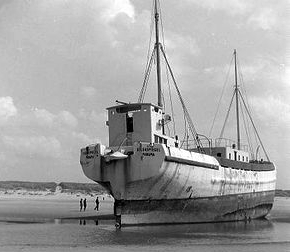
Over the years the Uilenspiegel, having found her final resting place on the beach, with the bow pointing towards Antwerp, slipped ever deeper in the sand. For a long time the wreck remained a popular tourist attraction. Many Flemish day trippers and German holiday makers flocked to the remains of the legendary pirate. One afternoon in the mid 70’s also RNI-colleague Andy Archer and myself walked to the stricken wreck of the Uilenspiegel. Later a young German tourist broke his back as he fell from the hulk. The town council in Sluis subsequently decided to have the upper structure blown up. Afterwards parts of the concrete keel could still be seen sticking out of the sand at very low tide. In 2001 growing concerns over safety made the authorities incorporate the debris of the Uilenspiegel keel into a new breakwater. And so the former radio ship, that was wrecked by the power of the waves, became part of the coastal defences to keep in check these same waves, now egged on by global warming.

FISHY ROYAL PRIVILEGE

Few are aware that the ‘Nele’, Uilenspiegel’s very small tender, went on to make history of her own. In 1963 Victor Depaepe, who lived in Zeebrugge, found a document in the city archives at Bruges which was signed by King Charles II and had been forgotten for some 300 years. After his father had been beheaded, and since Cromwell was in power in Britain, the then Prince Charles took up residence in several European cities, each time until the money ran out or politics forced him to move on. From 1655 he also spent time in Bruges. Charles was running up large bills in the town and did not have the means to pay them. That’s when he had an ‘Eternal Privilege’ drawn up. This granted 50 Bruges fishermen -appointed by the town- the everlasting right to fish in British territorial waters. 

In 1963 the ‘Nele’ was renamed ‘King Charles II’ and Victor Depaepe –whom everyone called Fik­ken Poape- set sail and soon started fishing just a mile from the English coast. This was what the maritime inspec­tors had been waiting for. Sea fishery officers came on board and con­fiscated the catch. The Royal Privilege was said to be no longer valid. But Victor Depaepe (1922-1997) was not prosecuted and hence did not get his day in court, which he had hoped and prepared for. 

Many years later when the Public Record Office in London released documents relating to the Depaepe-incident, here too unsavoury cover-up politics transpired. Lawyers for the British Minister of Agriculture had advised to avoid a court case against Victor Depaepe because it would prove that the privilege issued by Charles II was still very much legally valid.  So it proves that the legitimate aspirations of the people behind both the Uilenspiegel and the Nele largely foundered on the deviousness of politicians.

More of AJ's radio- and other anecdotes.

Saturday, 10 February 2018

11. MYSTERY STATION

In the 60’s many shortwave listeners, myself very much included, were puzzled by a mystery station which broadcast the same song over and over again. It was a badly modulated recording of Shirley Bassey belting out "Kiss me honey, honey, kiss me. Thrill me, honey, honey, thrill me. Don't care even if I blow my top, but honey, honey, don't stop!" The song was on a looped tape which lasted for just over two minutes and was then repeated. This went on for hours and hours on several frequencies and could be heard in most parts of the world. Here in Europe it was especially loud on 11.696 kHz near the edge of the 25 m band. The mysterious broadcast persisted for many years!


In the end it appeared that the endlessly repeated song was a new form of jamming. Usually communist countries trying to prevent their citizens from tuning in to broadcasts from certain Western countries by broadcasting loud oscillating sound waves on the same frequencies. Instead of producing this dreary, wobbly white noise the mystery jammer enlisted the the ‘help’ of Shirley Bassey to irritate would be listeners. First Cuba was blamed, then Iraq. The mystery was never really solved convincingly. Ultimately the most likely culprit proved to be Tehran trying to block communist sponsored broadcasts from Radio Peyk-e-Iran (Radio Free Iran), which were aired from East-Germany and later from Bulgaria. In 2006 the American State Department declassified information according to which Radio Peyk-e-Iran in its broadcasts in the 70’s regularly praised Khomeini for his “struggles” in support of “freedom, democracy and anti-imperialism”.

More of AJ's radio- and other anecdotes.

10. THE LONGEST ‘GOLS’ IN HISTORY

In the early 60’s, before Radio Caroline came on the scene, I used to travel the world every night in bed, an earphone plugged in and the small transistor balanced on my chest. I could hardly wait for dusk to reach South-America. As soon as the path between my home and the America’s was in total darkness the most exotic signals would be wheedling their way to my bedroom. Wintertime was the best since the sun set early and conditions were soon right for the sky wave to work its magic, especially in the 60 m band. And thumbing below the sheets my right hand had been well trained to find even the weakest local stations in Venezuela and adjacent countries. I even taught myself some Spanish for the purpose. Although I must say that Assimil’s ‘Español sin esfuerzo’ at times was still too much ‘esfuerzo’ for my liking. In spite of my learning French –a related language- at school, there was still quite a bit of effort involved before I started to understand a modicum of Spanish. A big help however was the fact that in Latin America the language is properly pronounced and clearly enunciated. In Spain on the other hand people sound permanently ravenous as they gobble up at least half of every word they speak.

Although I have never been much of a sports person –apart from basketball and squash- at times I even tuned in to football matches on the small Latin stations. That’s where I for the first time heard a goal being scored, a Latin goal that is. The ‘gooooool’ shout by the commentator on ‘Ecos del Torbes’ went on forever. Well, at least for well over a minute. By comparison goals scored in my neck of the woods are most modest affairs. Many internet blogs claim that the extended gol-screams were introduced in the 80’s by Hispanic television commentator Andrés Cantor in the States. This obviously is a total fabrication as the practice was already in full swing on Latin radio 20 years earlier. That fact has recently been confirmed by Cantor himself, who admitted: “Yo no inventé nada. La manera de gritar el gol está inventada hace mucho tiempo”.

The Venezuelan station ‘Ecos del Torbes’ was big on sports. It broadcast from San Cristóbal and had been on the air since 1947. Many years later, as luck would have it, when preparing offshore Radio Paradijs, I was to meet its founder Don Gregorio Gonzalez Lovera in the States.


Night time listening in bed offered me many years of atmospheric entertainment. Amongst my favourites were the Windward Islands Broadcasting Service from Dominica, Radio Rumbos in Venezuela and Radio Reloj from Costa Rica. In later years, being able to tune in to Radio Reloj even came in handy one eventful night on board the Mebo 2, as I will recount later.

More of AJ's radio- and other anecdotes.

Friday, 9 February 2018

09. MORE UN-PC PECCADILLOES

With hindsight it proved that, a few years later, my next choice of favourite shortwave broadcaster was also most politically incorrect! My aim had been to pick up Springbok Radio in Afrikaans, because it is a language that is easy to understand for speakers of Dutch. That proved no simple matter, as these broadcasts were for domestic consumption only and not directed towards Europe. So I had to settle for Radio RSA broadcasting in Dutch from Johannesburg. In spite of the fact that it was the mouthpiece of the apartheid regime I was fascinated by the station. So much so that I collected titbits of radio news in a stencilled magazine called ‘Bokmakierie Express’. The name referred to the unique species of yellow, green and grey coloured ‘bush-shrike’, a bird native to Southern Africa. Even to this day, when I hear the loud melodious song of the Bokmakierie mixed, as it was, with RSA’s station call "Ver in die Wêreld Kitty", it still makes the hairs on my arms stand on end.

Some years after that, in 1970, even a Radio RSA listening group was formed during a get together in Utrecht. Most of us were in fact fans of ‘De puntjes op de X’, RSA’s dx-programme presented by Chris Uitzinger (1926-2006). Not to be outdone by the Dutch, a year later a garden party was organized in Belgium, at the home of antenna-specialist Hubert Carton in Loppem, near Bruges. As South-African officials were going to be present at this do, I popped in at the embassy in Brussels. The group wanted to make sure, that whoever was going to put in an appearance at our meeting, was well aware that our love of Radio RSA did by no means extend to the racist policies of the South African government. Having delivered this message, the Embassy’s chargé pointed to the corner  of his  office and  told me to “pick up the stick” that stood there. “Surely, he’s not going to beat me” I thought. Seeing that I was reluctant to follow his order, he added “walk with it”. Later the chargé explained that the artfully carved walking stick had belonged to Paul Kruger (1825-1904) the first president of the South African Republic (Transvaal) and the face of Boer resistance against the British. The walking stick, called a kierie in Afrikaans, was on its way back to RSA, having been on display at an exhibition in The Netherlands. 

As it happens, it was on Radio RSA, that my voice first hit the airwaves. In November 1969, at the studio of RSA-member Izaak De Kramer in Tongeren, we both recorded season’s greetings for the X-mas edition of Chris Uitzinger’s DX-programme. It was weird to subsequently hear one’s voice filter through the static from half a world away. Soon however even more outlandish things were waiting in the wings. But first, I had to wade through a few more acres of shortwave real estate. 

08. WHATEVER WILL THE NEIGHBOURS THINK

Although it was not against the law, my mother was not too happy about me listening to pro­grammes -in Dutch or otherwise- from the USSR. Her displeasure grew ex­ponentially how­ever when I re­ceived a letter from Russia and the postman decided to deliver it to the wrong address, a bit further up the road. “Whatever will the neighbours think”, she sighed disapprovingly. My mother, having seen the Gestapo at close quarters during the war, felt sure that our family must now be under the watchful eye of whatever equivalent organisation was bound to be in existence in Belgium… I, on the other hand, was delighted having received a commemorative pin and a letter (on cheap rice paper) singing the praises of Gherman Titov. On the 6th of August 1961 he had become the second man in space. In the event it proved that my early flirtation with Russian radio did not summon the secret police to our house, much to the relief of my mother. 

Radio Moscow be­gan broadcasting to The Netherlands and Flanders as far back as 1930. During the height of the Cold War Russia was on the air in 65 languages, including three half hour programmes in Dutch every evening. The station had one of the best known interval signals. Moscow could be picked up easily in shortwave and -from transmitters in East Germany or the Baltic states- also on medium wave. Transmissions in Dutch and many other languages were discontinued in 1994, when the roubles ran out, some time after the collapse of the Soviet Union.

More of AJ's radio- and other anecdotes.
07. GLOVER GLEE FROM DOWN UNDER

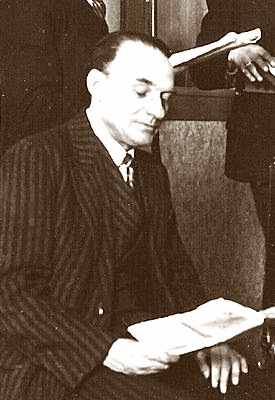
Soon however, I drifted further afield discovering pastures new in shortwave. Another early favourite was the Mailbag presented by Keith Glover on ABC, the Australian Broadcasting Commission in Mel­bourne. There was no mistaking his typ­ic­al nasal twang as the signal hopped across the globe on a Sunday mor­ning. His voice sounded as fam­iliar to me as the Kookaburra’s call. Keith even sent out airmail letters to tell listeners in advance when they were going to be mentioned on the airwaves of Radio Aus­tralia. Those were the pre-streaming days when distance still had magic. Radio Australia’s pro­grammes usually came booming in on a rock steady signal in the 25 m band. 

Mentioning the Kookaburra just now, I feel I must recount the story Keith Glover told on the air one Sunday morning. He explained that laughing Jacko, the broadcasting Kookaburra (the largest of all kingfishers) was captured in the bush whilst minding its own business sitting in a gumtree. The bird was brought to the studio and was coaxed into performing its uncannily loud call, echoing human laughter. When the sound engineer played back the recording, Jacko was so startled that he promptly fell off his perch.  Although today the familiar symbol of Radio Australia is the Kangaroo, long ago it was more often the laughing Kookaburra. Laughing Jacko combined with Waltzing Matilda was for many years Radio Australia's world famous interval signal.    

In the beginning -when my knowledge of English was still a bit higgledy piggledy- I was also deliberately seeking out stations that offered programmes in Dutch. That made for some unlikely bedfellows, as both Radio RSA in Jo­hannesburg and Radio Moscow became regular haunts of mine. Hearing my own language spoken from so far away obviously gave me some kind of kick.

More of AJ's radio- and other anecdotes.

06. STARTING WITH STARTZ ON SHORTWAVE


One of the first broad­casters I was captivated by, when initially roaming the short­wave, was “Happy Sta­­tion”. That was the special Sunday morning program­me broad­cast world­wide by Radio Netherlands. Little did I know that many years later  I would be in more or less the same time slot when presenting “North Sea Goes DX” on RNI. “Happy Station” was in fact the oldest running radio pro­gramme in existence. It was presented by the multi-lingual Eddy Startz (1899-1976), who had started his transmissions for the Dutch company Philips in Eindhoven in 1928. As a young boy in 1960 I was very much taken with Startz’s happy chatter and the mixture of Dutch street organ music and marches by John Philip Souza. Although Souza wrote over a hundred marches, the one that sticks out in my memory is “Stars and Stripes Forever”. On the rare occasions that he was stormbound and at home, my father was also very fond of the programme. In the kitchen, only yards away, my mother was oblivious to it. She seemed to prefer cooking Sunday dinner to any form of entertainment that did not include the then German heartthrob Freddy Quinn. Who were we to complain, when we were about to be treated to succulent chicken in a thick brown sauce! It has to be said, all my mother’s dishes were deliciously Delia, avant la lettre.

More of AJ's radio- and other anecdotes.

Thursday, 8 February 2018

05. GETTING TO GRIPS WITH BBC ENGLISH

On New Year’s day 1961, I saw my meagre savings gratefully topped up by my grandmother. That meant that on the second of January I could go radio hunting in Bruges clutching a 500 franc note (just over £4 at the time), being the sum of my worldly possessions. My quest for a new, inexpensive and cheap to run portable radio of the transistor persuasion was soon met with success. I returned home with a small hand-held radio, an ear-to-ear smile and 5 francs to spare.

The new transistor radio fulfilled all my expectations. It was small, loud, clear and cost hardly anything to run. Apart from that, it managed to capture far away stations that had failed to register on the Tesla. An added bonus, which I only discovered after I got home, was the fact that the set even had ‘Shortwave’! 

Whilst studying in my room I also started listening to ‘English by Radio’ from the BBC. Every day I tuned in to programmes for beginners and intermediate learners. The lessons were broadcast on 648 (where now Caroline lurks :) and 1296 kHz, the loudest channels on the Medium Wave at the time. I sent off £ 2.5 to an address in Brussels and subsequently obtained a year’s subscription to a weekly magazine, which included the texts of the dictation exercises that had been broadcast the previous week. That was a great help for a budding learner of English. After many spelling trials and tribulations I got quite good at it. In fact I had turned learning English into a hobby. Thanks to the BBC my knowledge of the language increased in leaps and bounds. I didn’t have the faintest idea then, that at some time in the future I would become a stringer for one of the BBC stations. I’m sure that would never have happened if it had not been for that small transistor radio. 

More of AJ's radio- and other anecdotes.

04. PORTABLE RADIO BLUES

It was in the late 1950’s that I became a regular listener to Radio Luxemburg, the English service in the evening on 208m Medium Wave. I vividly remember sitting at the dining table with my father enjoying ‘Wooden Heart’ by Elvis on Luxy. It must have been 1960, as at the time the song was in the hit parade for weeks on end. Tuning in to Radio Luxembourg was like a breath of fresh air, maybe even akin to being fed a few liberal doses of pure oxygen. Until early in 1960 Luxemburg was the only radio station in the whole of Europe that played the latest records non-stop. It was the same year I started to learn English at school. I was 13 then.

My teacher in Heist, Xaverian Brother Ildefons Rotsaert, spoke proper King’s English, but devoted much of his tutoring time perfecting his hate of Communism. Although I was very determined to do well, after the first week I proved to be the worst pupil at English in the whole class. Apparently I had even failed to grasp the correct spelling of the ‘definite article’. The shame was too much to bear! This wasn’t supposed to happen. My father’s family had spent the entire war in England and many family members felt more British than the Brits. No wonder I kept quiet about what I considered to be ‘an absolute disaster’. Before my parents ever found out I had turned things around. So much so, that just days later I was ‘best of class’ for English, and remained so. However that was not the case for many of the other subjects. But I considered that to be of lesser importance…

A few months earlier, by continuously pestering my parents, and purposely doing rather well at school, I was allowed to choose my very own transistor radio. Well, that is not exactly true. My parents bought me a portable radio. It was the cheapest model available, but still a heavy strain on my mother’s purse. For a while I was ecstatic with my -medium wave only- red and cream coloured ‘Tesla Minor’. It was built in Czechoslovakia but still had vacuum tubes instead of transistors. As a result my infatuation with radio soon turned into too high maintenance a love affair. My Tesla Minor became a major disappointment as it only performed after ingesting a bulky and expensive battery, which in addition was very short lived. Especially since I spent long hours listening to Radio Veronica, the offshore station which had just started broadcasting off the Dutch coast in April 1960. That was a full four years before Caroline’s bell tolled. I remember walking to my grandmother’s during the Summer of 1960, with my Tesla tuned to 192m, listening to Veronica. I might just as well not have bothered to bring the portable. On a warm day in Heist one could hear Veronica’s hits and ‘Nur Die’ commercials just about everywhere as they poured into the streets from every open door and window. That Summer it seemed all land based stations were out of favour.  No prizes for guessing why.


The luxury of having a portable tube radio however utterly drained my finances. Hence, the Tesla set was soon demoted. It was put in the corner of our veranda and the small loudspeaker was hooked up to the main radio. That way we could also listen whilst enjoying the Summer sunshine. The main thing was that it didn’t cost me anything anymore, which meant that I could save up for a proper transistor radio.

More of AJ's radio- and other anecdotes.

03. THE THEATRE OF THE MIND

It soon proved that my mother’s wireless set survived unscathed my many manipulations. Hence, the rules were further relaxed. This meant that I was now allowed ‘on the Medium Wave’. The increasingly appealing LW and KW, which stood for Long Wave and Short Wave, remained off-limits however. No reason was given, but I think my mother feared that engaging too many of the push buttons on the wireless box might upset some delicate balance in the innards of the set.

On the new stomping grounds my attention was soon drawn by the children’s programmes in Dutch broadcast from Hilversum in The Netherlands. To me they were slightly more appealing than any of the Flemish programmes on our own Belgian NIR, which stood for quite a mouth filling ‘Nationaal Instituut voor de Radio-omroep’.

As I grew a bit older I became captivated by so-called ‘Hoorspelen’. In English they were known as radio plays. Through them the wireless became my very own Tardis. The actors -with only their voices- magically transported me to another place, a different time and new sensations. With no visual component these audio dramas depended on dialogue, music and sound effects to help the listener imagine the story. As a result they were often referred to as “the theatre of the mind”. Radio drama became very popular before television ruined everything. That’s why even today I often only listen to Eastenders whilst doing some work on the computer. I like to think that my imagined version of the goings-on in Albert Square somehow has the edge. 

Looking back, the effectiveness of radio drama was probably best born out by a Halloween radio special broadcast by CBS in the States. In 1938 Orson Welles proved so good at communicating with his listeners and creating the theatre of the mind, that he drove a nation into panic (if the papers of the day are to be believed, that is). In the radio adaptation of ‘War of the Worlds’, he presented H.G. Wells’ novel as a simulated news broadcast. People believed it and ran into the streets with wet towels as make­shift gas masks to protect against the poison gas the radio said was headed to­wards them. Many had no doubt that civili­zation was laid to ruin by invading Martians and were convinced it was the end of the world. One particular farmer who, when hearing about the menacing Martian war machines with their tenticular arms and stilt-like metallic legs, is said to have gone out into his field armed to the teeth, ready to do battle with the alien monsters. In the darkness the poor man mistook his neighbour’s water tower for one of the gigantic Martian invaders, blowing several large holes in it with his shotgun.

In the seventies we had a copy of the broadcast as performed by the Mercury Theatre in our music library on board Radio North Sea. In fact on September 17, 1973, ‘Daffy’ Don Allen put the ‘War of the Worlds’ double LP on the air in it’s entirety on RNI. The album, lasting for over an hour, had just been released in Europe. While it was playing, the dj’s on the Mebo apparently sat listening in the darkened studio. Graham Gill was reported to have chewed off all of his fingernails during the performance. Unfortunately I wasn't on board at the time. In connection with the ‘War of the Worlds’ many people have remarked that when they approach the towers of Red Sands Fort -the former Maunsell Sea Fort home of Radio 390 in the Thames Estuary- they are immediately reminded of these woeful Wellsian war machines.

More of AJ's radio- and other anecdotes. 

02. TRAWLING THE FISHERY BAND

About a year later entertainment did come to the house, but it was not intended as such. My greatgrandfather, Leopold Vantorre (Pol Mussche), had decided to install a ship-to-shore transmitter on the remaining fishing vessel he owned (Zeebrugge 34). This meant that if we wanted to receive updates from my father during his fishing trips we needed a wireless set. It was to be my mother’s wireless set, of course. With the money for a first instalment payment in her purse we set off to Bruges. In those days that was the nearest place where radio’s could be bought.

In Degraeve’s wireless shop there was only a limited choice. The owner suggested a state of the art German Saba receiver. It would be delivered later in the week, since first the innovative FM-module had to be ripped out and replaced by the Fishery Band. That was standard procedure for all the families of fishermen who went to buy a set at the shop. To sacrifice the so-called UKW (Ultra Kurtz Welle) was no great loss. At the time there were no FM-broadcasts in Belgium yet.

Installing the new set at home also meant spanning a wire antenna between insulators high above the yard to enable reception of the fairly weak transmissions emanating from the fishing trawlers. Upon my mother’s insistence the antenna wire was also fed through quite a number of evenly spaced wine corks. This was not to flaunt the illusion of wealth, since we never drank wine in those days, but to prevent any near-sighted pigeons in the neighbourhood meeting an untimely death by flying into this unfamiliar obstacle. Also, from day one it was made clear to me that the receiver was only to be used to listen to the news from Brussels (NIR) on Medium Wave and to the calls on the Fishery Band. In addition I was not -under any circumstance- to interfere with the set, since I was liable to break it. For the same reason, I also had to keep my distance, lest I accidentally brush against it.

These rigid rules and regulations soon changed however. Switching on the set to tune in to national radio was easy, but fine tuning to 126m or 133m in the Marine Band soon proved a bridge too far for my mother. So whenever I was not at school I got happily lumbered with the task. Three times a day I made sure that we could hear my father’s messages. Amid the cacophony of calls I usually recognized my father’s signature whistle before my mother did. As soon as I made out the first few notes of “Over the rainbow” I turned up the volume to hear the message. Richard Briers later whistled the same tune in the “Good Life”, just like my father did all those years ago... But in spite of my obvious monitoring talents I was still only allowed to touch the UKW-button for the Fishery Band. The rest remained temptingly out of bounds.

But I soon discovered that at the far end of this band some music could be heard. That was the area where the Marine Band spilled over into the lower end of the Medium Wave. And late at night it got even better with mysterious stations fading in below the Maritime Band as well. At the time I did not have an inkling that in equatorial parts of the world this Tropical Band was used by local broadcasters as a substitute Medium Wave. The ordinary Medium Wave being too prone to interference by electrical storms. In a nutshell, that is how I became lord and master of the mock-ivory UKW-button on my mother’s radio. Unbeknown to her the conquest of the rest of the wireless set was now on my to-do list.

More of AJ's radio- and other anecdotes.

01. THE WIND-UP GRAMOPHONE DAYS

I was a mere toddler when I first came into contact with radio. It was at my grandmother’s house in a place called Heist, on the Belgian coast. I vividly remember my aunt Gilberte doing the ironing to the music on the BBC Light Programme. Occasionally also my boisterous self was sushed into silence because the Archers were on. These daily exploits ‘of country folk’ were not to be missed. My aunt had been listening to the BBC, especially programmes like "It's that man again", throughout most of the war, when the family lived and worked in Cornwall. 

It was also in early infancy (my neighbour had only just taught me how to curse properly) that I discovered the wonder of music. That happened when my mother ‘inherited’ a vintage wind-up gramophone, because her great-aunt Clementine went into a retirement home, and had no further use for it. The sturdy wooden box arrived with a large number of very fragile records and handfuls of steel needles. Much to my father’s and my surprise the gramophone was not awarded pride of place in my mother’s living room. Without any malice intended, my mother was in the habit of calling everything ‘hers’. Hence it was ‘her house’, ‘her garden’ and ‘her everything else’. The only exceptions being the dustbin and the ditty-bag with ship’s provisions. They were described as ‘yours’, meaning my father’s. Although there was no form of entertainment in the house, the gramophone, with all its intriguing possibilities for a young boy like myself, was banished to her ‘spare room’. It was a small bedroom, which stood largely empty, and had no bed in it. There the gramophone sat for a long time, forgotten by everyone, but me.

Being only six at the time, it took me a while to pluck up courage to go and investigate this tantalizing toy in my mother’s third bedroom. In the end, making the best of unguarded moments, I managed to figure out how the contraption worked. After many failed attempts it finally produced some sound, mostly scratching. More ‘fiddlings’ later however Beniamino Gigli and Maurice Chevalier were singing their songs perfectly in tune. That is, until I was slow in winding up the handle. Then these great stars tended to forget their lines.

The fun didn’t last long however and I was found out. But my father, who for once was not at sea, came to the rescue. He figured, that since my mother wasn’t doing anything with the gramophone, I should be allowed to play with it. I’m sure my parents regretted this very soon. During the Summer break, which lasts for two months in Belgium, my gramophone playing day started at seven in the morning. I opened the window in the small upstairs room and began waking up the entire neighbourhood with musical and opera hits from as far back as the roaring twenties. As in the early 50’s ‘noise pollution’ had not yet been invented there were no complaints. The early morning antics of Josephine Baker, Lucienne Boyer and Jean Gabin went unchallenged. With hindsight it definitely was the barely tolerated airing of these hits from ‘les années folles’ that gave rise to my love of music. 

More of AJ's radio- and other anecdotes.