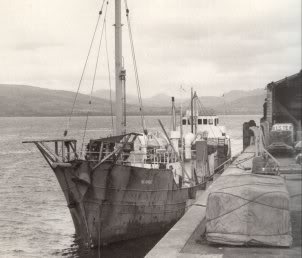
A month and a half later, immediately after Caroline signed off at 6 p.m., I heard Radio Atlanta go on the air from the Mi Amigo. She too had been equipped at Greenore. The vessel had anchored off Frinton-on-Sea and used the same frequency as Caroline, introducing herself as the “ship that rocks the ocean”. To me it felt as if my Christmases had all come at once. For the first time in my life there was an abundance of pop music available at the flick of a switch; sheer luxury. No wonder that whenever the sun was out beach-goers had their transistors blaring up and down the East-Anglian coast. On the Belgian beaches it was no different.
I remember Bob Scott, one of the initial dj’s on the Mi Amigo, announcing between records ‘You are tuned to Radio Atlan(t)a. This is a test format’. The station’s name was often pronounced without the second ‘t’ by some of the Americans on board. Testing on Caroline’s wavelength after it had gone off the air in the early evening, meant that the newcomer could advertise its presence to a ready-made audience. Regular programmes began on May 12th 1964 using 1493 kHz, 201m, the old Uilenspiegel haunt. In the early days transmissions were between 6 a.m. and 6 p.m., but were soon extended to 8 p.m.
The programmes sounded very mid-Atlantic and a number of maritime-related slogans were used. The dj’s referred to the station as ‘the most on the coast’ and a rather corny sounding ‘the music queen of the seven seas’. The music on Radio Atlanta was distinctly different. Probably because the station's boss, Alan Crawford, gave ample air-time to many cover versions by little-known artists on his Cannon and Sabre labels. Indeed he was no stranger to recreating the hits. Crawford even produced a cover of the famous Fortunes hit ‘Caroline’.
More of AJ's radio- and other anecdotes.

In 1964, like modern day successors to the 16th century French, Dutch and English privateers off the Spanish Main, suddenly a flurry of radio pirates popped up along the British Main, being the Essex coast and the Thames Estuary; often described as pirate alley. Unlike their Caribbean predecessors, who went after Spain’s silver bullion, the pop pirates had set their sights on London’s advertising dollar in an attempt to break the monopoly of the BBC and the large record companies. The pioneer in the race to lay claim to the lucrative London market was Radio Caroline, financed by Irishman Ronan O’Rahilly, who hoped to emulate Veronica’s success. A former Danish passenger ferry Frederica was bought, renamed Caroline and fitted out as a radio ship in the Irish port of Greenore, owned by Ronan’s family. After two days of tests off Felixstowe Britain’s first offshore station opened officially on Easter Sunday, March 29th 1964. Ronan had been egging on everyone connected with the organisation in order to be able to inaugurate the station on that day.
In
fact, at the time, I only heard about Caroline going on the air on
Easter Monday, as I was spending my school holidays in the small
Belgian village of Beerzel (near Malines) where my maternal
grandparents lived. My immediate problem was that Caroline’s
broadcast on the announced 199m (in fact 1520 kHz) was too close to
Belgian regional radio in Antwerp. But as luck would have it my niece
Maria Goris, who had just married, was in possession of a large
Phillips portable radio, which could be turned away from most of the
splutter involuntarily caused by the Antwerp station on the adjacent
channel. After a few minutes’ tuning and turning the sound of
Caroline’s bell rang through the small house. It would change my
life forever. Over the years the start of Caroline has also become a
very important date to me personally. More than half a century later I
still use it as an all important benchmark. In my life BC means
‘Before Caroline’.
More of AJ's radio- and other anecdotes.