Showing posts with label Frinton-on-Sea. Show all posts

Monday, 19 February 2018

26. LAST TIN OF TUNA, IN LONDON ENGLAND

Shortly after the former US minesweeper Density (renamed Galaxy) arrived off the coast of Frinton-on-Sea (Essex) in the second half of December 1964 listeners -like myself- immediately were charmed by one of the most successful American jingle packages. It was created by Pams of Dallas and consisted mainly of the so-called series 18 “Sonosational”. The initial jingle repertoire had been further enhanced by scores of clever edits. It was Radio London's early programme director Ben Toney, a Texan, who had overseen the production of Pams Radio London jingles.

In the 50's and early 60's US stations had developed a tradition of using a superlative connected with a station name, like “Colourful KQV” and “The Mighty 690”. Jingle beds had been composed to allow for such superlatives. That's the reason why Radio London became “Wonderful Radio London”. The station was also referred to as “Big L”. A lesson learnt when years later we were managing local station Radio Dynamo in Knokke-Heist (Belgium) and called it “De Grote Dee” (The Big D).

Creating Radio London's jingle package to a large extent meant adapting jingles that had been made for other stations in the States. That is why unexpectedly also a jingle in Spanish was lurking in the series: “Esta es la estación número uno en London England es mi favorita. Wonderful Radio London, Olé!”. (6th jingle) This caused some confusion. Because the jingles were so fast and slick not everyone could easily understand some of the lyrics, especially when they were suddenly confronted with a foreign language. Hence it is no surprise that 10 year old John Bennett was completely baffled by Big L's 'Spanish jingle'. It resulted in a beautiful piece of mondegreen. John thought he heard “It's the last tin of tuna in London England, see the ballerina. Wonderful Radio London. Olé”.

More of AJ's radio- and other anecdotes.
 

Monday, 12 February 2018

15. MID-ATLANTIC

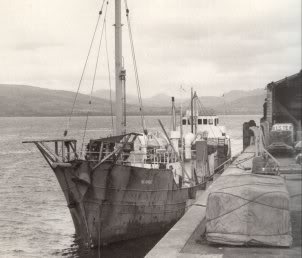
A month and a half later, immediately after Caroline signed off at 6 p.m., I heard Radio Atlanta go on the air from the Mi Amigo. She too had been equip­ped at Greenore. The vessel had anchored off Frinton-on-Sea and used the same frequency as Caroline, introducing herself as the “ship that rocks the ocean”. To me it felt as if my Christmases had all come at once. For the first time in my life there was an abundance of pop music available at the flick of a switch; sheer luxury. No wonder that whenever the sun was out beach-goers had their transistors blaring up and down the East-Anglian coast. On the Belgian beaches it was no different.

I remember Bob Scott, one of the initial dj’s on the Mi Amigo, announcing between records ‘You are tuned to Radio Atlan(t)a. This is a test format’. The station’s name was often pronoun­ced without the second ‘t’ by some of the Americans on board. Testing on Caroline’s wavelength after it had gone off the air in the early evening, meant that the newcomer could advertise its presence to a ready-made audience. Regular programmes began on May 12th 1964 using 1493 kHz, 201m, the old Uilenspiegel haunt. In the early days transmissions were between 6 a.m. and 6 p.m., but were soon extended to 8 p.m. 

The programmes sounded very mid-Atlantic and a number of maritime-related slogans were used. The dj’s referred to the station as ‘the most on the coast’ and a rather corny sounding ‘the music queen of the seven seas’. The music on Radio Atlanta was distinctly different. Probably because the station's boss, Alan Crawford, gave ample air-time to many cover versions by little-known artists on his Cannon and Sabre labels. Indeed he was no stranger to recreating the hits. Crawford even produced a cover of the famous Fortunes hit ‘Caroline’.

More of AJ's radio- and other anecdotes.